The Science of Breathwork
Transform your biology.
The Science of Breathwork: How 60 minutes, once a week, can transform your biology
New research reveals why conscious breathing is becoming the protocol of choice for those seeking profound change without pharmaceuticals. Feel happier, more energized, more connected and look younger, while shrinking anxiety, fear and depression.
In November 2025, UC San Diego researchers published findings that should have made headlines everywhere: seven days of intensive breathing practices created brain changes identical to those seen with psilocybin therapy. No substances, no prescriptions. Just breathing.
For anyone managing chronic stress (burnout), seeking deeper meaning, or simply tired of feeling disconnected from themselves, this research validates what thousands have already quietly discovered: breathwork is a biological reset button backed by hard science.
Corporate and Private Breathwork Programs
High intensity breathwork is very effective if practiced consistently, over an extended period of time.
If you are interested in experiencing the profound benefits of Neurodynamic Breathwork® to perform better, reduce burnout and feel more content. Private sessions are available in blocks. Book a free call to find out more.

What’s Actually Happening in Your Brain
When you engage in rhythmic breathing for 60 minutes, your brain undergoes three measurable transformations that explain why participants often describe the experience as “years of therapy in an hour.”
First, your Default Mode Network (DMN), the brain’s inner critic responsible for rumination and self-referential thinking, shows significant deactivation. This is the same network turned off by psychedelics, achieved through breathing alone. When the DMN turns off you open the door to your subconscious mind.
By doing breathwork on a regular basis, along with profound physical and emotional releases during the sessions, you will strengthen the neural pathway to your higher consciousness, or inner guiding intelligence (IGI), and be able to access this intelligence more consistently on a moment to moment basis in your life, by just taking a few deep breaths. With practice it becomes like a switch you can turn on and off.
Second, you experience transient hypofrontality: your prefrontal cortex, the part that constantly analyzes and censors, temporarily quiets. This creates access to emotional material and creative insights normally locked away. The breakthrough moments people pay therapists for years to help them reach can be reached in a much shorter window.
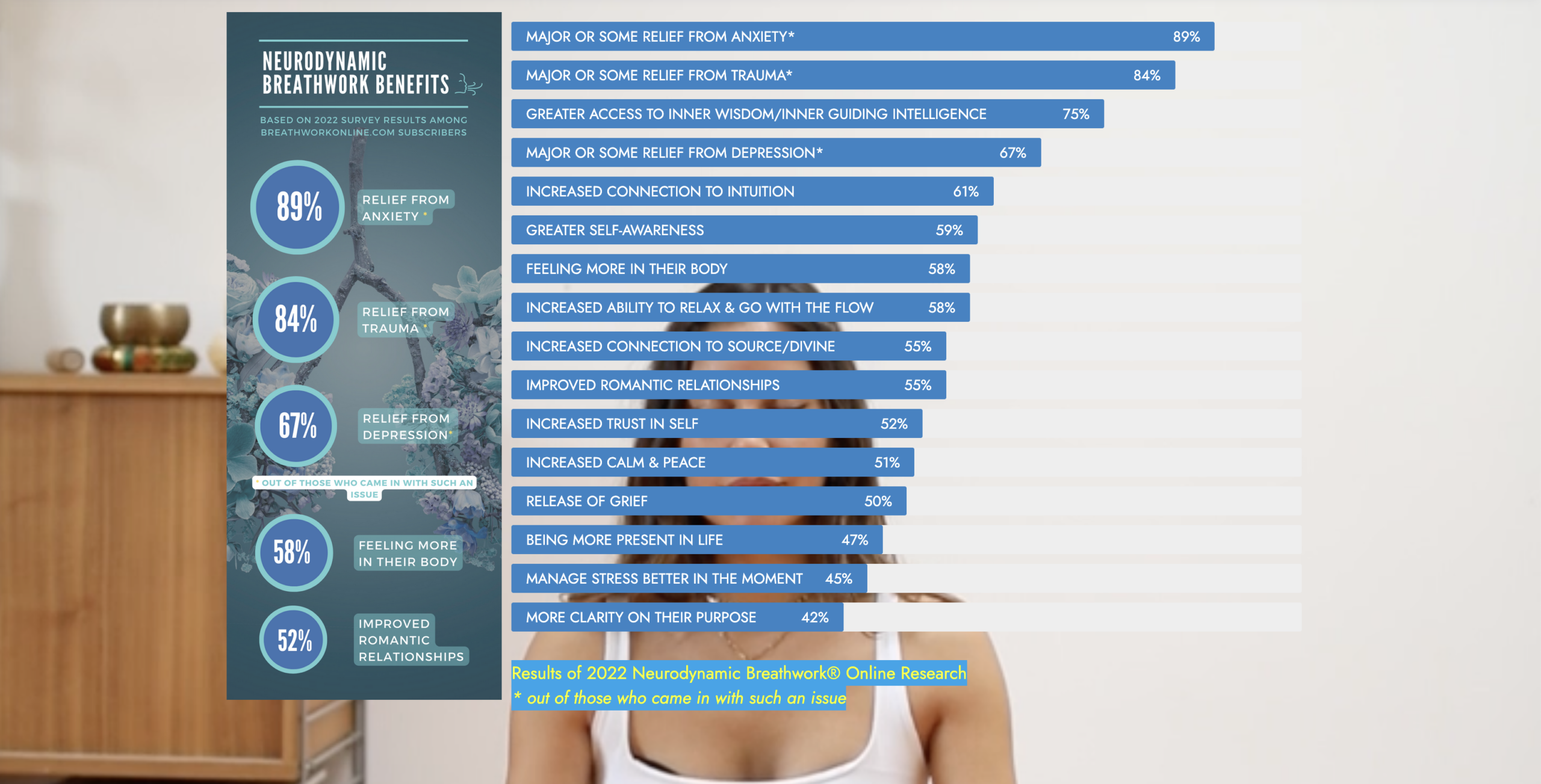
Clients report experiences such as getting insights into issues in their lives, improving their relationships with their friends and family, feeling less isolated and more connected to the world, and, with consistent practice, being more present which makes it possible to make the best choices for themselves and their families on a moment to moment basis. Your choices are what makes you, you.
Third, this combination triggers what researchers call an “optimal neuroplasticity window.” Your brain literally becomes more malleable, allowing you to overwrite patterns that have run your life for decades. This is where re-coding and integration come in.
The summation of this journey, building and strengthening neural pathways – relaxing our thinking mind completely, directing the spotlight of our attention inward – toward the stream of remote associations emanating from the right hemisphere of our brain. In contrast, when we are diligently focused, our attention tends to be directed outward, toward the details of the problems we’re trying to solve.
While this pattern of attention is necessary when solving problems analytically, it actually prevents us from detecting the connections that lead to insights and intuition. When you start doing breathwork on a regular basis, you will have more access to this inner intelligence that can produce the answers to the questions that our thinking minds cannot resolve through analysis.
Your Body’s Pharmacy
Here’s some documented results typically unfolding during a 60-minute session:
Minutes 0-20:
The Activation –
As CO2 levels drop through controlled breathing, your blood pH shifts toward alkalinity. This triggers HIF-1α (hypoxia-inducible factor), which activates over 300 genes involved in cellular repair. Your body interprets this as beneficial stress, mobilizing stem cell repair mechanisms typically dormant in comfortable modern life.
Minutes 20-40:
The Cascade
– Your body begins producing its own pharmacy. Human Growth Hormone surges. Beta-endorphins, your bodies your natural painkillers, flood your system. Studies document a 26% increase in circulating stem cells, your body’s renovation crew. This isn’t relaxation; it’s active cellular regeneration. Others call it the anti-aging effect.
Minutes 40-60:
The Integration
– As you return to normal breathing, oxytocin and serotonin release creates what participants describe as “coming home to yourself.” But this isn’t just feeling, blood tests confirm elevated oxytocin levels persisting 48-72 hours post-session. Your Heart Rate Variability, the gold standard for stress resilience, improves by 40% immediately.
Turning Back Your Biological Clock
Research on breathwork’s anti-aging effects centers on three key mechanisms:
Telomerase Activation:
A 2011 study in Psychoneuroendocrinology found intensive meditation training increased telomerase activity by 30% over three months. Telomerase protects and rebuilds telomeres, the protective caps on chromosomes that shorten with age. Subsequent research shows breathwork creates similar telomerase activation patterns. When breathwork is combined with mediation the results compound.
Stem Cell Mobilization:
Studies on intermittent hypoxic breathing demonstrate a 26% increase in circulating stem cells. Stem cells are essential for tissue repair and regeneration, stem cell release in the body typically declines with age. The mechanism involves HIF-1α activation, triggering stem cell release from bone marrow. When you combine breathwork and diet you compound autophagy revitalizing mitochondria.
HGH Production:
Research consistently shows breathwork triggers Human Growth Hormone release comparable to high-intensity exercise. HGH drives cellular repair, metabolism, and IGF-1 production, which promotes tissue regeneration with documented anti-aging effects.
With long term practice the stacking effects of these functions can reduce your biological age significantly.
Blood Pressure and Inflammation
For anyone dealing with hypertension, which affects roughly 47% of adults over 50, breathwork offers measurable improvements. A systematic review in the Journal of Alternative and Complementary Medicine found slow-breathing exercises reduced Systolic and Diastolic blood pressure.
These reductions are clinically significant, and comparable to blood pressure medications. This is achieved through enhanced vagal tone and improved baroreceptor sensitivity. Baroreceptors play a crucial role in regulating heart rate and vascular tone to maintain stable blood pressure levels.
Chronic inflammation, the hidden driver of aging, shows dramatic improvement. An 8-week diaphragmatic breathing study published in Frontiers in Psychology documented:
• IL-6 (interleukin-6) decreased by 35-50%
• TNF-α (tumor necrosis factor alpha) reduced by similar margins
• C-reactive protein (CRP) showed measurable decreases
• Oxidative stress markers improved significantly
These inflammatory markers are key indicators of chronic inflammation, which drives aging and most age-related diseases. IL-6 and TNF-α are pro-inflammatory cytokines, they signal proteins that trigger inflammatory responses throughout the body, contributing to conditions from cardiovascular disease to cognitive decline.
C-reactive protein (CRP) is produced by the liver in response to inflammation and is a predictor of heart disease risk. Oxidative stress markers measure cellular damage from free radicals, which accelerates aging at the molecular level. When breathwork reduces these markers by 35-50%, it’s essentially turning down the body’s inflammatory response system.
Like switching from chronic survival mode to normal functioning, allowing cellular repair processes to work properly again.
Burnout – Real Recovery, Not Just Rest
Whether you’re running a company, raising a family, or juggling multiple responsibilities, burnout has become epidemic. Research shows breathwork addresses it at the source:
Cortisol Reduction: Multiple studies document 20-30% decreases in cortisol after 8 weeks of regular practice. A 2023 study combining aerobic exercise with slow deep breathing showed even greater reductions of 30.29% when combined versus 20.16% for exercise alone.
Heart Rate Variability: A 2022 study in Applied Psychophysiology and Biofeedback found:
• 40% immediate improvement in HRV following single sessions
• 35% sustained baseline improvement after 3 months
Dr. Hemal Patel, the UC San Diego study’s senior author, noted the brain changes resembled those seen with psychedelic compounds – but achieved naturally, legally, and safely. The best part you breath every day, all you have to do is take control of it.
Intuition and Connection
Research on interoceptive awareness, your ability to sense internal signals, shows breathwork enhances this capacity significantly. This isn’t woo-woo, it’s measurable:
• Increased insula activation and connectivity
• Enhanced accuracy in heartbeat detection tasks
• Improved “gut feeling” accuracy in decision-making scenarios
For anyone who relies on pattern recognition, creative problem-solving, or simply wants to trust themselves more, improved interoception translates to better instincts backed by measurable brain changes. Better choices and smarter decisions made in alignment with your higher consciousness create more synchronicity, joy and flow state in your life.
During the integration phase (40-60 minutes), research documents significant increases in oxytocin, the “love hormone,” that’s also a powerful anti-inflammatory. Studies show oxytocin can improve wound healing rates by up to 30%, reduce cortisol, and create lasting anti-anxiety effects for days.
Research Indicates Women May Experience Enhanced Benefits
Perhaps most compelling: breathwork directly regulates the HPA axis that controls the stress-hormone cascade, naturally rebalancing hormonal disruptions that come with perimenopause, menopause, and chronic stress.
Women also have higher interoceptive sensitivity, meaning faster access to profound states and breakthrough insights. One additional strength, women have a greater density of oxytocin receptors – this amplifies the love hormone’s effects, creating more profound feelings of connection, accelerated healing, and that sense of “coming home” to yourself.
The Experience Science Can’t Fully Capture
While biomarkers are impressive, what keeps people coming back is something studies struggle to quantify: the experience of profound connection to themselves, to others, to something larger as well as improvement in their interpersonal relationships.
Participants consistently report experiences with measurable neurological signatures: feelings of oneness, universal love, deep knowing. Brain scans show enhanced connectivity between usually isolated regions, particularly the insula and posterior cingulate cortex. These are the same patterns seen in advanced meditators and psychedelic research. Imagine the outline of your body and inside of it is the cosmos.
For those who’ve spent years in their heads, this embodied experience often provides insights that analysis never could. As one client noted: “I finally understood what I’d been chasing my whole life, and realized it was already inside me.”
The Investment Comparison
For those tracking ROI on wellness investments:
Traditional Approaches:
• Therapy: $10,000-40,000 annually, addressing psychology without biology
• NAD+ infusions: $500-1,500 per session, temporary effects
• Prescription medications: Ongoing costs plus side effect management
• High-end retreats: $10,000-50,000, powerful but temporary
Breathwork:
• Initial investment in proper training
• Once learned, minimal ongoing costs
• Practice anywhere, anytime
• Benefits compound over time, muscle memory steps in
The Data Summary
Based on peer-reviewed research, regular breathwork practice (3-4 sessions weekly for 8-12 weeks) shows:
• 30% increase in telomerase activity
• 26% increase in circulating stem cells
• 20-30% reduction in cortisol
• 35-50% reduction in inflammatory markers
• 10-15 mmHg reduction in blood pressure
• 35-40% improvement in HRV
• Significant improvements in interoceptive accuracy
These aren’t marginal improvements, they represent clinically significant changes in biomarkers directly linked to aging, stress-related disease, inflammation, and cognitive decline.
The Reality Check
Let’s be transparent. The UC San Diego study involved 20 participants. Some research is funded by organizations with vested interests. Long-term studies beyond 12 weeks are limited. Each person has their own experience and individual results will vary.
But here’s what matters. The consistency across independent research groups, the measurable biomarkers, and thousands of people experiencing profound, lasting change. You don’t need science to tell you what you actually feel.
Your Next Step
This isn’t about believing in something mystical. It’s about measurable changes in telomerase, cortisol, HRV, heart-brain coherence, and neural connectivity. It’s about accessing the biological intelligence that’s always been there – before stress took over your nervous system.
The question isn’t whether breathwork works, the research and reviews are very clear. The question is whether you’re ready to experience what UC San Diego researchers documented – profound biological transformation through conscious breathing.
For those ready to discover what 60 minutes can do, the science and the experience awaits you.
Contraindications
Please confirm you are healthy to participate.
**There are certain health and psychological conditions that preclude some individuals from participating in intensive breathwork practices. Please carefully check the list below.
For your safety, please do not participate if any of these conditions apply to you:
1. Under the age of 18 | Pregnant | Epilepsy | Detached Retina | Glaucoma | Severe PTSD
2. Aneurysms (if either you have had, or if more than one person in your immediate family (parents, siblings, children) has had one)
3. High Blood Pressure (that is not controlled with medications
4. Cardiovascular disease (and/or irregularities including prior heart attack)
5. Osteoporosis (that is serious enough whereby moving around actively could cause physical damage to your body)
6. Bipolar Disorder or Schizophrenia (a prior diagnosis by a health professional)
7. Hospitalization for any Psychiatric Condition (or serious emotional crisis in past 10 years such as an attempted suicide, nervous breakdown or psychotic break)
8. History of Strokes, Seizures or TIAs, or if you’re taking prescription blood thinning/ anti-clotting medications
9. Recent Head Injury (or other physical injuries that are not fully healed and could be re-injured through movement)
If you have asthma, you are welcome to breathe, but please have your inhaler available.
Neurodynamic Breathwork® (NDB) is intended as a personal growth experience and should not be looked upon as a substitute for psychotherapy. NDB can involve experiences accompanied by very strong emotional and physical release. This workshop is not appropriate for pregnant women, or for persons with severe cardiovascular problems, severe hypertension, severe mental illness or acute infectious illness.
In some specific cases, this workshop would also not be appropriate in cases of recent surgery/fractures or of epilepsy or various other conditions. Further, we ask that you do not participate if you are taking any opioids/ opiates.
This web site is provided for educational and informational purposes only and does not constitute providing medical advice or professional services. The information provided should not be used for diagnosing or treating a health problem or disease, and those seeking personal medical advice should consult with a licensed physician. Always seek the advice of your doctor or other qualified health provider regarding a medical condition.